Covid 19, Housing And Predicting What’s Next

So a lender friend called me tonight.  He told me how he’s got amazing rates for Conforming loans and very good rates for High Balance Conforming loans but his Jumbo loans are gone.  Only a few big banks are doing Jumbo he said.  This of course is reminiscent of 2008 when the financial markets seized up and no one could get financing done except through a handful of big banks.  He also said all his investor clients are stock piling cash so they can pounce wolfwhen the foreclosure market comes back.  “Hmmm…” said I.  To which my friend said, “What, you don’t think that’s what’s going to happen?”  “No” I said, “I do not.”

This is an interesting conversation that I thought I should delve into.  Of course, I am only speculating, and I could be just as wrong as anyone else; just as easily as I could be right (Reach out to Tim here).  If you’ve ever read my blogs before, you know I am never afraid to put my Carnac hat on and put my two cents worth of opinions out there.  carnacRight or wrong, I’d like to hazard a guess as to what’s going to happen next.   So here goes.

I told my friend that I did not think we are going into a period of substantial foreclosures.  On the contrary, I believe the Federal Government is going to give mortgage and rent forgiveness.  In fact, the $2T stimulus passed last week even includes some rent and mortgage deferment opportunities.  Many states are already announcing freezes on evictions.  HUD has said much of the same on the government backed loans like FHA.  No one wants foreclosures and a repeat of 2008.  I am convinced that the Federal government is going backstop the banks having learned from the financial crisis.  I think the time will come when the Feds condition all the bank bailout monies on short term mortgage forbearance.  Let me explain my thinking.

What is the largest expense most American face every month?  Cars, student loans, credit cards, private schools?  No, it’s housing.  (Search for Homes HereDSC03726Housing for families either in rent or mortgage and same for businesses in the form of commercial leases.  Whether that be in very expensive states like California or less expensive like Arkansas.  Whether that be homeowners, tenants or landlords, housing is the biggest monthly expense.  And let’s not forget, landlords.  Landlords mostly have mortgages too.  Big commercial landlords and mom and pops.  This is where the proverbial Covid 19 rubber hits the roadCovid 19.  As the pandemic goes from days to weeks to months, the economic toll will increase.  For the moment, the concern is keeping small business alive so it can come back.  But what happens when this goes on far longer than many are willing to say?  The cost goes up and the pittance the government is going to send most Americans will only cover food and utilities.  Rent and mortgage become the obvious pitfall.

So then, what is to happen?  I predict Washington will step in and not let anarchy prevail.  Something will need to be done and that something is mortgage and rent forbearance.  Why?  Supporting banks answer is the easiest thing for the government to do.  They have the Federal Reserve and the Treasury.  So, hear me out:  The best way to keep households and businesses solvent is to put a freeze on their largest expense.  This will mean however that the holders of those notes and servicers, will need compensation.  Again, this is where the Federal Reserve can play a part and support the banks and keep them whole.  Out of fairness, those property owners without mortgages will have to receive tax credits via the Treasury.

Mortgage and rent expense, is the key.  Put it on hold until the economy gets back on its footing and we can survive.  Bank vs peopleAllow foreclosures and you guarantee that banks and investors will strip the nation of its wealth, create a homeless crisis which in turn will lead to a health crisis and then we end up with that movie we’ve all seen and no one wants that.   Some counties are already moving in this direction by allowing time if you miss payments to repay and get current, and by preventing evictions.  What I’m talking about is on a national scale.

Let’s see how this plays out.  I personally feel this will go longer than most expect but that the fundamentals of the economy and real estate specifically can weather this storm.  And think about this: As we are all sequestering and sheltering in place, think about your home.  If you’re stuck in place for weeks or months on end, you better like your home and if you don’t or if you’ve been renting waiting to buy, you have to be thinking, “Get me out of here!”  Yes, as soon as this passes, people are going to want to buy.  DJI_0966Hopefully in a couple weeks the crisis shows signs of abating and more drastic measures won’t be required.  Let’s pray for that outcome but as we do, let’s also begin thinking about what happens next in  the event this drags on much longer than we hope.

Posted in Real Estate | Leave a comment

Relocating To Thousand Oaks And The Conejo Valley: What You Need To Know

The first thing you need to know about relocating to the Conejo is that it’s pronounced Koh-nay-hoe not Cone-Joe.  Conejo means rabbit in Spanish.  The Conejo Valley is one of the most beautiful places on earth and arguably the most special in Southern California.  The weather is near perfect.  The schools incredible.

schools

For more school info click here

You can go for a breathtaking hike with ardent hikers or your 5 year old one minute and then at the beach the next.  We are located midway between Downtown Los Angeles (think Lakers, Kings, Clippers, LAFC, The Galaxy, Angle City, WMLS, world class museums and Broadway theater) and Santa Barbara (think romance, wine tasting, art walks and shopping).  Both are 45 minutes without traffic so allow for 1.5 hours as a rule, this is greater LA after all.  We have a regional trauma center and hospital and a fashionable indoor-outdoor mall with Nordstrom’s.  You’ll find a vibrant biotech hub including biotech giant Amgen, along with Takeda, Atara, and start ups Capsida and Latigo not to mention food giant Dole, music giant Guitar Center, insurance giant Anthem, the LA Rams and the list goes on and on.  Home to nearly 200,000 people (about 400,000 when you factor in neighboring Calabasas, Camarillo, Moorpark and Simi Valley) it’s a fantastic place to live, to grow old in or to raise a family.

Thousand Oaks, the area’s largest city, has more than a thousand oak trees.  They’re beautiful and grand.  Should you find one on the property you like, be advised that you can’t cut it down.  You can’t even trim a branch if it is larger than 4 inches in diameter.  Suffice it to say the fines for damaging or removing an oak tree in Thousand Oaks are hefty.  We do love our oak trees and they are protected.  We also love our open space and the Conejo Valley is completely ringed by protected regional, state and national park land including the majestic Mt. Boney, the last mountain in the Santa Monica Mountain range.  It makes for spectacular outdoor scenery and activities but it also means you won’t find many new homes being built.

balcony view of Boney.jpg

Mt. Boney

The Conejo Valley rests atop the Los Angeles and Ventura County lines.  For example, Westlake Village which is home to our most expensive real estate, was incorporated in 1981.  However, Westlake Village makes up only half of what we consider Westlake.  This is because a California city cannot be in two counties.  Thus, when Westlake Village

westlakesign resized

Westlake Village

became incorporated only the LA County side was allowed to do so.  The Ventura County side was absorbed into the city of Thousand Oaks.  The zip codes for Westlake south of the 101 Freeway are 91361 for both counties.  The address used is Westlake Village.  Go north of the freeway and it’s 91362 and called Westlake Village for both counties as well.  More significantly, the school districts are entirely different.  If you want your kids to go to Westlake High School (Conejo Valley Unified School District) you must live on the Ventura County side.  The LA side goes to Agoura High (Las Virgenes Unified School District.)

In 1982 Agoura (pronounced Uh-goor-uh) incorporated into Agoura Hills, leaving behind a swath of homes over the Ventura County border in unincorporated Ventura County.  This area originally known as Agoura now bears the name of Oak Park.  Oak Park has its own zip code: 91377, its own government and most importantly its own Blue Ribbon school district (Oak Park Unified School District.)  Unlike Westlake, Oak Park successfully resisted incorporation into the city of Thousand Oaks.  When you ask someone about Oak Park the first thing they mention are the schools.  Since most of the schools throughout the Conejo Valley have Great School rankings of 9 out of 10 or better, the fact that Oak Park is known for schools means something special is going on there.

To recap the craziness of the various municipalities and the County Line, we’ve got two Agouras, two Westlakes and three schools districts.  There are unincorporated areas as well as 3 sub-cities in Thousand Oaks: T.O. proper, the aforementioned Westlake (part of T.O.) and to the south west, Newbury Park.  Temperatures by the way vary from Agoura Hills to the Newbury Park by as much as 15 degrees on a hot summer’s day.  Newbury Park is cooler since it’s closer to the ocean.  Nothing demonstrates this unique nature of our boundaries better than Westlake Island (and yes there actually is a lake in Westlake).  The entrance to the gated island is by way of a street named La Venta.  This is derived from LA/Ventura because the road is literally the county line.  In fact, “The Island” is smack dab in the middle of the lake (Search for Westlake homes here) and is literally divided in half.  Half on the Ventura side, half the LA side.  The Conejo is also home to three other lakes.  Two that you’ve likely not heard of are Lake Lindero and Malibou Lake.  Malibou Lake (yes like caribou) was a cabin-on-a-lake getaway for Hollywood Celebrities as early as the 1930’s.

Agoura Malibou lake above

Malibou Lake

I can picture some famous Hollywood actor bouncing across the San Fernando Valley on a then two lane Ventura Blvd., up and over the Calabasas grade then left into the canyons, finally pulling up to a cabin nestled above Malibou Lake in the foothills of the Santa Monica Mountains.  Homes with lake rights are actually part of a co-op called The Malibou Lake Mountain Club and offer a truly unique lifestyle in the mountains while only being 7 minutes to Agoura and the 101 freeway.  The lake many people may have heard of is Lake Sherwood, another example of unincorporated Ventura County.  Built around the sensational Jack Nicholas designed PGA quality golf course, this community of mostly single family homes starts in the high $2M’s with town homes in the mid $1M range.  The Sherwood Country Club has hosted the Tiger Woods Open

shergolf2

Lake Sherwood Golf Course

and Greg Norman’s Shark Shootout golf tournaments and boasts the only tennis club that features all 3 court surfaces.  Lake Sherwood was named after Sherwood Forest because Errol Flynn’s 1938 classic film Robin Hood was partially filmed there.  Lake Sherwood is unincorporated Ventura County and like it’s even more expensive horse ranch neighbor Hidden Valley, has no municipal government.  Resident children attend the Westlake schools on the Ventura County side.  In addition to our amazing public schools, the Conejo has a multitude of private schools including Oaks Christian which spans all ages and has had their share of famous name alumni/alumni parents, plus a bunch of other parochial and non-parochial including the esteemed Carden School.

Another curiosity for most first time visitors here is that the Pacific Ocean is both to the west and the south.  We are located on the odd part of the California coast line where the state bends so that the ocean is on two sides.  Not a big deal but this tends to throw off your sense direction since the 101 freeway runs north-south from San Francisco to Los Angeles except the portion from Ventura to the San Fernando Valley, where it runs east-west.

As for housing… that’s my expertise.  In spring 2025, the least expensive single family home was in the upper $700K’s.  Prices range to 8 figures when you include Sherwood, Hidden Valley and a handful of homes near the North Ranch Country Club in Westlake.  The median is somewhere around $1,200,000.  You can also find town homes and senior housing where prices are under those marks and even into the $300K’s.  Neighboring Calabasas is generally comprised of pretty high end, gated neighborhoods while Simi Valley, Moorpark and Camarillo (pronounced Kamm-a-ree-oh) offer a greater variety.  If you ask residents in each of those adjacent cities, they will tell you all the reasons they actually prefer their town to Thousand Oaks, Westlake or Agoura.  In Moorpark for example, when the little league season opens, the entire town shows up for the parade.  Moorpark also is home to Moorpark College part of the Ventura Community College system and a natural feeder into UC Santa Barbara, my alma mater.  Drive down the major streets of Simi or Moorpark and you’ll see banners heralding local young men and women who are serving in our military.  Heck, Simi Valley is home to the Ronald Reagan library.

ronald_reagan_libary

Ronald Reagan Library

Camarillo will tell you that at sea level you don’t need air conditioning and that it’s home to the Camarillo Airport, the outlet mall and Cal State University Channel Islands with its newly created school of engineering.  Located on what was once the California State Mental Hospital, the buildings of CSUCI also claim to be the inspiration of the Charlie “Bird” Parker song, Relaxing In Camarillo.  Being a professional musician and Arista recording artist in life BRE (Before Real Estate) I love that trivial fact…  Other nearby major universities include California Lutheran (also known as CLU or locally referred to as Cal Lu) once the off season training grounds of the Los Angeles Rams and Dallas Cowboys and of course Pepperdine University in nearby Malibu.  Yes, Malibu and everything it offers, is just 13 minutes from the Conejo Valley via Agoura Hills or Calabasas.

Moving to a new area can be a big life-change, but the Conejo Valley is one place that it shouldn’t be.  The Civic Arts Plaza

Civic Arts and Gardens shots 025

Civic Arts Plaza

offers great entertainment, touring shows etc., CVUSD has wonderful programs for kids in the autism spectrum (see my Special Needs Resource Guide here), Moorpark has great horseback riding; baseball and soccer reign supreme in all the towns.  Virtually every religion is represented including several Catholic churches, the 7th Day Adventist church and Academy, giant Calvary Community Church, Presbyterian, Lutheran and Methodist churches, the Malibu Hindu Temple, multiple Mormon temples, a several Jewish Synagogues plus Chabad, New Age Global Truth Spiritual Center and we even boast a Mosque in Newbury Park, copper dome and all.  The canyon roads are popular for motorcycle and sports car enthusiasts as well as cyclists, not to mention vintage watering holes like The Old Place and The Rock Store and half a dozen Farmer’s Markets.  So if you’re moving to this area, consider yourself blessed to have such a wonderful place to call home.

tim_cy_home

Tim

The old timers still use 1000 Oaks, Ca on their return envelopes (thinking about buying or leasing?  Visit http://www.1000OaksRealEstate.com  here) and will proudly refer to our Valley as God’s Country, because it really is that beautiful.  There’s a lot to talk about if you are relocating to Southern California.  As a native Californian, California real estate broker, Certified Residential and Corporate Mobility Specialist, I’d like to help with your relocation (contact Tim here).  Whether you’re looking for a luxury estate property or a more modest family home or condominium, let me welcome you to your new home right here along The County Line (read The County Line Gazette Newsletter here).

Posted in Corporations, Home Buying, Real Estate, Relocation, Thousand Oaks | 2 Comments

Buyer’s Market or Seller’s Market? Depends On Who You Ask

I wrote a couple months ago that this was a seller’s market, and the buyer’s just don’t know it yet.  And today’s Case Shiller report suggests there may be changes afoot in our housing market: it may be heating up.  I suppose most will attribute this to the decline in interest rates, which is traditionally a catalyst.  I’d like to suggest something different.  I’d like to suggest, wait for it… it’s a supply and demand issue.  There’s an old saying many have attributed to Mark Twain, no not “Buy land because God ain’t making anymore,” though that is a good one; rather it’s ‘Figures won’t lie, but liars will figure.”   Let me explain.

Case Shiller’s numbers of course are backwards looking.  When a market is in decline or slowing, those figures are behind the actual changes.  When the market is accelerating, well it’s also behind the times.  In other words, Case Shiller is helpful but old data.  So Case shows us today, that over the past month the closed sales from contracts written back in July and June (30-60 day escrows), were slightly higher in price than the previous month.  From this they draw the conclusion we’re heating up and suggest the decline in interest rates since the first of the year may be the reason why.  The figures don’t lie, prices are up a little.  They did note however that the big cities of NY, SF and LA showed little to no gain, and Seattle actually declined.  A mixed bag as it were.  Good if you live in Tampa, Phoenix or Charlotte and a “Meh” pretty much everywhere else.

In my business, I sell throughout greater Los Angeles and Ventura County (Contact Tim Here). And like any large metropolitan area, the data varies wildly from town to town, neighborhood to neighborhood.  Since I tend to do most of my work along the LA/Ventura line, I’m going to use that data as I’m most familiar with it.  Specifically today, I want to use Calabasas to make an example.  Many of you may only know Calabasas as where the Kardashians started, but it’s actually a really interesting place to call home.  Being that it is the closest east you can live but not be in LAUSD, it has a certain panache.  Great schools and big homes, many behind gates, will do this for you… Calabasas and the adjacent celebrity filled horse property community of Hidden Hills isn’t very large to begin with, so it doesn’t take a whole lot to bend the data.  If I were a lying figure bender, to channel Twain, I’d point to the fact that there are a ton of homes in excess of $2M and based on the absorption rate of 11.8 month’s inventory, it’s a buyer’s market.  Pretty hard to argue that.  Looking at all over $1M that figure drops by more than half to 4.8 months, still a buyer’s market per California standards.  But when you look more closely you find that in the $1-2M price range, inventory drops down to 2.1 months; clearly a seller’s market.  Even more dramatic is the fact that out of 139 active listings, there are only 38 under $1M which equates to less than 2 months inventory.  Yet, when we look at those $1-2M listings we find an average cumulative days on market of 74 and average price reduction of that active inventory of nearly $200,000.  Huh?  With those numbers we have to wonder:  Is it really a seller’s market, because if so, why are some homes just sitting?

Here’s the deal, and this is true across most of the markets I work, there isn’t a lot of inventory, but the inventory that is available is not what the buyers are looking for; at least not at their current listing prices.  For this reason we are seeing substantial price reductions and extended days on market.  The supply is not consistent with what is in demand.  Circling all the way back to Case Shiller however, things may be heating up but I’d suggest not because of interest rates. (Search for homes here.)

I am noticing a two-fold shift.  The first is that inventory is in decline.  This is seasonal and of little surprise, unless you are of the “we are heading into a real estate correction” camp where you’d actually expect an increase in inventory as demand wanes.  But it’s not, and for this group the declining inventory is a surprise.  The second thing I am seeing is that buyers are actually writing offers, low offers, and sellers are actually taking that opportunity to negotiate and are accepting far less than their asking prices.  This is what I’ve been counselling my buyers to do: write an offer you think the property is worth regardless of asking price and see where the seller is at.  That’s what you do when a home is sitting and appears to be grossly overpriced.  This is in contrast to waiting for a price reduction.  Some sellers will be insulted and not respond, but you’d be surprised that many are coming back with substantial price concessions.  But here’s the rub, while I’ve been encouraging my buyers to write, guess what?  Others are doing the same thing and as a result homes that have been sitting and sitting, are suddenly in multiple offers, because the sellers of the overpriced inventory are negotiating and making deals.  One house we wrote $200K below ask, then the seller countered $110,000 below ask.  We were told it might even go for a little less, but then another offer came in above us and game over.  This has now happened on 3 offers in Calabasas in the past week for two different buyers.  Prices are correcting but that’s pouring fuel on the fire of an already tight market.

If you actually read this far, bravo, I’ve thrown a lot at you.  Here’s the thing, if inventory is declining and overpriced sellers are finally coming to the table and negotiating and those units are being absorbed, in the absence of substantial new inventory and in the face of steady demand, guess what’s going to happen?  Just as Case Shiller has suggested, the market is heating up and that means prices will rise, because the numbers don’t lie.

#CaseShiller #MarketConditions #RealEstate #TimFreund #DilbeckEstates #HotMarket # HomeSales #Realtor #Blog #Calabasas #ThousandOaks #LosAngeles #LA

Posted in Economics, Home Buying, Home Selling, Market Conditions, Real Estate, Tim Freund | Tagged , , , , , , , , , , , , , , , | Leave a comment

A Case For Keeping Freddie And Fannie Redux

Yesterday the US Treasury and Steve Mnuchin, laid out a plan to take Freddie Mac and Fannie Mae private… again.   Obama and his administration proposed pretty much the same idea as Secretary Mnuchin 104559814-RTS195ZV-steve-mnuchinand the Trump administration six years ago.  The argument goes, the US government should not be in the home lending/guaranteeing business.  In fact that the US government shouldn’t be in business of any kind.

The following is a reprint of an article I wrote back in August 2013.  (Contact Tim Here) This was at a time when the real  market was just coming out of its recession.   I’ve made a couple of corrective notes to update facts which I’ve italicized, but my position is essentially the same now as it was then.  Take a look:

The President (Obama) came out two days ago in support of the conservative agenda to do away with Fannie Mae and Freddie Mac.  But there is something that I just don’t understand about the push by the President and Congressional conservatives, why?  I guess the concern is that the tax payer could get stuck with the bill again should there be another down turn.  After all, the government had to take over the public/private companies following the financial crisis and the tax payer had to “bail out them out.”  The cost to the tax payer of saving Fannie was $117B and $72B to save Freddie.  To date Fannie has repaid the taxpayer $105B after posting another quarter of record profits while Freddie $41B.  (The profits posted to the US Treasury by Fannie and Freddie to date are now in excess of $300B and counting.)  Huh, I think I like the government being in certain businesses.   In fact, at this rate by next quarter Fannie will be helping to pay down the Federal deficit or maybe since they’re in the lending business, help cover the skyrocketing costs of student loan debt by offering submarket interest rates to our youth.  (Are you listening Secretary DeVos?)  Does this make me a socialist?  I think not.  Rather, I think it just makes me logical.

You may recall that the reason the federal government had to step in and bail out General Motors, AIG and Freddie and Fannie, was that the financial meltdown threatened our economic foundation’s very existence.  Too big to fail, they said.  As a real estate professional I will never forget when the entire secondary loan market ceased to exist.  (Don’t forget, Fannie and Freddie are the guarantors of the loans made.  Those loans are sold to Wall Street investors aka the secondary market.  As a result  private industry does benefit because they are buying mortgages backed by the government..  And doesn’t it only make sense that if the U.S. Government, sans The American Taxpayer, as the guarantors of the loans, should also be the ones who profit?   It’s our money at risk in the event of another real estate meltdown.  Why should we take the risk without the benefit of the reward?)  The secondary loan market is the place where mortgages are sold by banks so that they replenish their capital so that they can turn around and lend again.  It is the very foundation of our economic system.  The secondary mortgage market used to be insurance companies and hedge funds.  This is why AIG aiggot into so much trouble; they bought bad bundles of high risk loans and when those loans were defaulted on, AIG had worthless paper.  Since AIG is primarily a life insurance company, it was reasoned that to let them fail would put countless retirees, future retirees and beneficiaries at risk of losing the insurance they’d been paying for and their survivors were depending on.  To save AIG, the taxpayer had to buy $182B in AIG stock.  Gradually the government sold its stake in AIG and eventually posted a $22B profit for the tax payer.  A 12% return on our investment.  Not bad if you ask me.

I suppose the argument against the US Government being in business is that they have an unfair advantage over the private sector.  To this I say, so?  In fact I would go a step further.  I would say that the government should be in a business partnership with the American people with regards to many businesses, not just the purchasing of home loans, as Freddie and Fannie do.  This idea that the government is not letting market forces free float and that that is somehow dysfunctional, fails to recognize in the case of home loans anyway, there is no secondary marketplace (there is now but why would we want wealthy Wall Street investors and insurance companies making the profits we are making?)  The insurance companies and hedge funds don’t want to buy home loans.  They could but they want higher rates of return.  Higher rates of return mean higher interest rates to the consumer.  (This is still true as these entities would screw Americans if it meant they’d make more money.  Capitalism unbridled is not in the National best interest.  In fact I’d argue the role of government in a capitalistic society is precisely to contain Capitalism which by definition is an economic model that puts profits above all else and at any cost.  Consider the most recent statement by the CEO’s just last week that corporations need to consider stake holders – that would be us common folk in the neighborhoods these businesses thrive and profit – not just share holders, as part of their mission statement. *see link)  19ROUNDTABLE-COMBO-superJumboThis is not in the best interest of the American public, but is for Wall Street money managers and the wealthy who can afford to invest in these companies.  So the argument is that the consumer should pay more so that the free market can be free.  Hogwash.  I want my government to work for me, (not pay for me, give me free or at the expense of free enterprise – I’m not a Socialist, just a working stiff who paid more in taxes than Amazon…) not the other way around.  I want the government to be profitable so I can pay lower taxes.  I want the government to make so much money, that my healthcare costs are lowered and our kid’s college education is made at least marginally affordable for the average family.  Taking this thought a step further, I advocate that the government should be in the energy business; in partnership with free enterprise.  For example, the government regularly grants leases to private companies to drill for gas and oil on public lands.  The leases we give pay us a fraction of the money and profit these companies earn. Because public lands are ours – we own them, they’re ours – I believe, we should be entitled to share in the profit.  A joint venture as it were.

When I worked for Shapell Industries, a Southern California home builder, they had joint ventures on land in Northridge, Long Beach and Laguna Niguel.  (Search for homes here) The JV partner didn’t earn as much as the home builder on every home sold,  but they did share in the profits.  With a public/private partnership on energy, we might for example, be able to restrict the sale of gas and oil extracted from our public lands to domestic refineries for domestic consumption, thus allowing Americans to buy fuel that is at prices that an owner would expect to pay – below market.  Why after all, should oil and gas extracted from public lands be allowed to be sold on the open market to China, forcing American citizens to have to compete and thus pay market prices when it came from our land to begin with?  Been to Saudi Arabia or Qatar?  Do you have any idea how cheap gas is there?  Try $0.48 per gallon.  (This was actually incorrect as this is a per liter cost not per gallon.)  What do you suppose the impact of that kind of cost for fuel would be on our domestic economy?  And I’m only talking about energy.  What about commodities like iron ore, copper, zinc etc., that are mined on public lands?  I think you see my point.

As it stands right now, Freddie and Fannie are turning a (huge) profit, helping to keep interest rates low for borrowers and there’s no one who wants compete with them anyway.  So there you have it, my case for keeping these lending giants firmly under government ownership for our benefit, we the people of the United States of America.  My name is Tim Freund and I approved this message.

Posted in Corporations, Economics, Home Buying, Real Estate, Tim Freund | Tagged | 2 Comments

Netflix’ Stranger Things Comes To The Southern California Housing Market

If you’ve not had the chance to see Netfilx’ Stranger Things, you’re missing out.  It’s a fantastic show.

*Spoiler Alert*

If you have seen the show, you know that it revolves around the premise strangethat there exists a parallel but alternative universe filled with darkness, bad things and monsters.  Where once inside, a person can become trapped or worse.  This is a lot like the current state of the housing market in Southern California, or at least it feels that way.

If you are a home buyer, you are looking at the housing market with a very wary eye.  Seems like prices are too high for what you get; homes have risen in value much faster than your income; sellers are generally myopic about the true value of their homes and darn it, the correction and possibly recession are coming.  Oh yeah, and the selection of homes in your price range generally sucks.  Price reductions are regular and in many cases, quite substantial, which further reinforces your opinion that the market is correcting. There’s no doubt in your mind, this is a buyer’s market.  But wait…

How can you have less than 3 month’s inventory (which we have here) and be in a buyer’s market?  3 month’s is the tipping point in California between and a buyer and a seller’s market according to me (Check Out My Newsletter here) and NAR says it’s actually 6 months which must be true nationally.  Therefore, at less than 3 months, by any measure or any metric, this is a seller’s not a buyer’s market!  And yet…

Homes are sitting unsold, but inventory is low, what the heck is going on?  Back to Stranger Things and the alternate universe… it would appear, we are in an upside-down world, where low inventory (supply) is not driving the pace of sales nor price of the homes sold higher, rather it’s the lack of buyers (demand) that is pushing them lower.  But if the economy is strong and unemployment is low, then it must be a seller’s market.  If it’s really a seller’s market or at least on paper anyway, why are interest rates at near historic lows?  A 30 year fixed rate mortgage in December 2018 would have cost you 5% while today, just 8 months later, it’s at 3.5%.  Clearly the bond market is signaling a recession or an economic slowdown, is forthcoming.  Yet unemployment is at 3.5% lowest, ever.  Many retailers (not mall retailers) are reporting strong earnings and growth, indicating a strong consumer and the stock market is near its all time high.   It is indeed a world of contradiction.  Just last week I showed a relocating client (Contact Tim here) no fewer than 20 homes spanning from Hollywood SignThe Hollywood Hills to Ventura.  We drove 285 miles in a day and a quarter.  We ultimately found a place that had reduced over $200,000 in Woodland Hills, wrote an offer and he bought it.  And although I was able to find some pretty cool homes in certain areas of Los Angeles, OvenI was not able to show him a single home (up to $1.4M) in Toluca Lake, Studio City, Sherman Oaks or Encino, that wasn’t under the freeway, backing the bus line,  on a major thoroughfare where backing out of one’s garage at rush hour was an impossibility or in some form of disrepair.  (Click here to find your dream home)  They were all on some lousy street or undersized or in mediocre condition for the price.  For those of you who don’t know this area, there are literally thousands upon thousands of properties we could have seen had any of them been on the market, but there were few available.  This is a real estate market where buyers can’t find homes because inventory is low, yet prices are declining.  Why?   Because the product that is available, no one seems to want at their current list price.  Meanwhile sellers ask, “Why am I not at least getting an offer?”  And this after reducing their price several times.  But this may be changing.

The showing volume on my listings (Check out my incredible listings here) has just this week picked up a bit.  Some of this is undoubtedly due to school starting and August (the worst month of the year for selling homes in So Cal) is rapidly coming to an (thankful) end.  Or perhaps it is this simple fact: when there is a shortage of supply, the existing inventory reduces to a point where eventually supply gets bought up and as that happens prices will firm and then rise.  Because despite what the buyers say or do, at some point the basic economic tenet of supply and demand takes over and the buyer that writes the offer and gets the nervous seller to accept an offer less than they thought they’d ever consider, will look like a genius.

Yes, this is Stranger Things alright, but just as with the show, eventually reality is bound to set in.


#LuxuryRealEstate #HomesForSale #StrangerThings #RealEstate #TimFreund

Posted in Home Buying, Home Selling, Market Conditions, Market Conditions, Real Estate, Tim Freund | Leave a comment

The Tale Of The Strangest Market

I must admit, writing this article I can’t help but wonder if my data isn’t incorrect.  The back story here is that I follow the inventory data pretty closely for my local marketplace.  (Contact Tim here) And as is the case every month, graphI look at how many active and pending listings there are, as well as the past one and two month closed sales totals.  I also track the percentage of the whole market that is under contract as this is a good leading indicator or future closings.  This month’s numbers are just plain confounding.  Let me explain…

Looking year over year, the Conejo Valley inventory is down 12% from a year ago.  Pending sales are also down 8%.  I suppose it could be that these two are tied together.  It stands to reason that if there are fewer homes for sale, there will be fewer pending sales.  Kinda makes sense.  If there’s nothing to buy then there’s fewer to close.  OK, maybe… What makes this even more confusing is the closed sales data.  Looking at June and July (contracts written April-June) year over year, sales are up, and by no small margin.  June and July combined sales are up 12% year over year.  July sales alone were up a whopping 20%.  I suppose it’s possible that buyers just bought up all the inventory and people haven’t listed to replenish it, but that frankly, is strange and difficult to believe.  Yet there it is.

Low inventory is nothing new.  (Find your dream here) We’ve been dealing with low inventory since the Great Recession broke. Then we had a surplus.  But it’s strange that more people aren’t selling.  There’s been a lot of speculation as to the reasons for this.  For a time the thinking went that because many people had the  very low interest rates of a few years ago, the cost to move up not just higher on price but also the cost to finance.  But that isn’t really true any longer now that rates have come down to 2016 levels.  Some have suggested the lack of inventory is creating its own shortage; making its own weather so to speak.  In other words, if there’s nothing to buy, why would I sell what I have and end up homeless?  This then leads to fewer listings and it creates and perpetuates a continued shortage.  Others still, point to the changes in the tax laws that reduced deductibility IRSof one’s top mortgage amount by 25%.  We do know for example the new tax laws capping state and local income tax (SALT) deductibility to $10,000 do not favor the wealthy in states like California.  Anyone who can afford to buy a $1,000,000 home, has to realize that the new law won’t even allow them to deduct all the property tax let alone the state income tax someone at the required-to-qualify income level, would have to pay.  I really believe that is impacting the high end where sales volume is way off.  The thing is though, if inventory is tight, the economy is pretty good and rates are low, homes should be selling fast.  But they aren’t.  So why aren’t homes flying off the shelves?

The Conejo Valley currently boasts 2.9 month’s inventory.  Said another way, if no new listings came on the market, it would take 2.9 months to sell all the homes available.  By virtually every measure, this is a seller’s market, it’s just that the buyer’s don’t  know it.  As I mentioned, homes aren’t selling as quickly as they were.  Most attribute this to an affordability crisis; that incomes haven’t risen at the same pace as home prices and buyers are suffering from price fatigue.  Thus we see prices are down in most areas and so are sales.  In fact, only 32% of all available homes are presently under contract.  This is a little lower than last year and an indication of slower activity.  As a point of reference, we dipped briefly below 30% in January but January is a tough read since so many days are lost to holidays.  Admittedly, August is the slowest month of the year and in fact, July has been pretty weak the past few years too.  I attribute this largely to back to school shopping, end of summer vacations etc.  Locally school starts before the 3rd week of August which is why July has become a slow month too I figure.  It used to be school started either right before or right after Labor Day.  But no more.  Anyway, whether it’s the political climate, the economy, affordability or any other host of excuses, it’s a strange market when closings from contracts written in late spring are exceeding the previous year, while actives and pendings are well below.  Time will tell as it always does, if this is a short term blip or a precursor to a more ominous market or even a forth coming recession.


Posted in Home Buying, Home Selling, Market Conditions, Real Estate, Recession, Tax Reform, Tim Freund | Tagged , , , , , | Leave a comment

Re-Marrying = Re-Evaluating Beneficiaries

Congratulations, you’ve just remarried and you’re thrilled. Did you know that 2nd marriages are on the decline in every demographic but one? Pew Research looked at remarriages in 1960 and compared them to 2013. What they found was surprising. Whether by death or divorce, in 1960 72% of men and woman between the age 18-34 and 35-54 remarried. In 2013 just 42% of 18-34 year old’s remarry while only 60% of 35-54 year old’s. But here’s the interesting part, in 1960 only 42% of people 55 and older remarried but fast forward to 2013 and that number jumps to 57%! More seniors are remarrying than ever.


And your point?”, you ask? Remarrying means you need to re-evaluate your real estate, will or trust, IRA or annuity. When you got remarried did you change how you hold title? If not and something happens to you, your new spouse might not inherit the house. Moreover, if you don’t re-evaluate how your other assets are to be divided amongst your kids, the assets could end up all going to your new spouse and maybe that’s just how you want it.

However, what happens when she passes? Your children could find they’ve been disinherited in favor of your spouse’s children and that may not be what you wanted. Even if you have a will or a trust, if you own an IRA’s or annuities you have to designate a beneficiary. If you don’t change the beneficiary after remarrying, whoever the original beneficiary is, gets it. That could be your Ex or it could your kids and not your new spouse. It could also still be your deceased spouse and then the IRA goes into probate.

In any event, if you remarry, take a moment. Review your assets in this new context and make sure what happens to your assets after your death is how you want it.

Posted in Real Estate | Leave a comment

Spotlight: Corelogic Case-Shiller April 2019

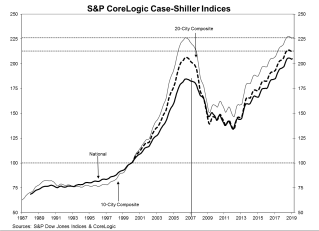
To channel Jan Brady of the Brady Bunch, data, data, data… The information out of Corelogic Case-Shiller today shows a slowing real estate market.  Slowing price appreciation anyway.  Sales we know have been slowing nationally for months, but it’s the appreciation slowdown that is garnering the most attention this month.  And for good reason.  Since 2012 the value of real estate has been steadily increasing.  Therefore a slowdown is noteworthy. Right?   Hmmm… maybe not.  Let’s look at what I find to be the most salient point in the Case-Shiller announcement.

graph_LI

As you can see by the red dashes, even with the spectacular rise since the housing recovery began, there have been periods where the value of homes either paused or given a little back.  In fact, if you look at the graph since its inception, as I’ve marked with the purple lines, during the relatively slow growth during the 1990’s, there were similar periods of appreciation moderation and give back.

So what’s the point?  The point is that while we are in a period where the market is slowing, it is neither uncommon nor unexpected.  Moreover, this is a period when the moderation, decline, giveback, or whatever you want to call it, should be viewed in the historical context as what it is: an opportunity.  I don’t think in looking at the Case-Shiller graph you can conclude anything else because look at the trajectory.  With the exception of the Great Recession and the epic collapse of equity value caused by Wall Street and lender greed via no income, no asset loans packaged as Mortgage Backed Securities and sold as solid AAA rated assets instead of the junk that they were, there has never been a sustained decline in real estate values.  Thus what we have here is a periodic opportunity to acquire real estate at a better price than we did a while back.  This “blip” will be looked back on, just as I have demonstrated here with my colored hash marks, as a period where those who recognized this for what it is and buy, will be thankful that they did.   Have questions?  Contact me here.

Posted in Economics, Home Buying, Home Selling, Market Conditions, Market Conditions, Real Estate, Real Estate Correction, Tim Freund | Tagged , , , , , , , | Leave a comment

The Legacy Of 1949: Don Newcome And The 1949 Housing Act

Don Newcome died yesterday. If you’re not a baseball officiando you may not have ever heard of him, but he was an important figure to baseball, the Dodgers, Los Angeles, and our country. You may wonder why a real estate blogger would take the time to write about a baseball player. Don Newcome’s story is the story of a changing America. The attitude of the country was shifting. The integration of baseball was the first step in popular culture towards equality, but when it came to housing, the year of Don Newcome’s arrival would prove to have negative ramifications that we still deal with today.

The year was 1949. Jackie Robinson had broken the “color barrier” of major league baseball just two years earlier. Baseball, America’s game, finally allowed people of color to join in. By 1949 there was still just a handful of black ballplayers, among them was the pitcher Don Newcome. Tall and powerful, Newcome was a man of firsts. He was the first African American pitcher to win a World Series game, the first to win 20 games and the first to win the league’s Most Valuable Player and Cy Young award for the year’s best pitcher in the same year. For the African American communities, seeing ballplayers like Robinson and Newcome excel was a great source of pride. Little did they know that at the same time, the Federal Government was conspiring to segregate America.

Segregation was nothing new in 1949. The landmark legislation of 1954, Brown vs. The Board of Education outlawing segregation in schools, was still 5 years away. Following World War II, where black soldiers fought and died with distinction, returning servicemen found little had changed back home. The South still lynched black men for looking at  white women, had white and colored only bathrooms, restaurants and hotels. But the South wasn’t the only place segregation and inequality existed. In fact, the Federal Government itself began a systematic push to restrict black homeownership. The 1949 Housing Act was designed under the guise of helping Americans buy homes by easing the ability to finance a home purchase. But it also gave the FHA tacit approval to rank neighborhoods for the purpose of restricting lending to white only neighborhoods and not just in the South. This happened in every city across America. Communities like Levittown in New York sold to whites only. This has been referred to as “White Flight” and lead to the creation of the modern American Suburb, the modern American white -only -suburb.

It’s hard to imagine today that a Government of the People and for the People would create a system that would specifically suppress a large segment of the people but that’s exactly what the 1949 Housing Act did. It allowed the FHA to create a color coded map which ranked geographic areas for lending, restricting which areas would be eligible for FHA insured loans. This served to restrict access to financing for many urban areas that had higher level of nonwhite residents. Today we call this Redlining and this phrase comes from the lines drawn around certain neighborhoods (check out local neighborhood sales here ). The effect of restricting the ability to finance meant, people of color couldn’t buy, couldn’t finance to make repairs and as a result neighborhoods rapidly deteriorated. The Act also had a provision that lead to the demolition of slums that supposedly was to spur building in declining neighborhoods but actually removed housing instead of creating it.

The impact of The Housing Act of 1949 is still felt today. As history has shown, people who own their homes have more wealth and pass that wealth to future generations. Since blacks weren’t allowed to buy, there was less wealth to pass and this is in large part why African American household wealth is so much lower today than that of the white population. Drop a stone in a lake and the ripples go all the way to the shore.

It is in this context that we look to a man like Don Newcome. He broke down barriers that would eventually culminate in the Civil Rights Act of 1964 and the Fair Housing Act of 1968. This is Don Newcome’s legacy and his contribution to this nation is invaluable. Want to chat about this article or real estate, just give me a call or send me an email.

Posted in Real Estate | 2 Comments

Interpreting What The Early 2019 Housing Data Means

The housing data that came out of the National Association of Realtors yesterday morning was not good. Sales were down 6.4% from last year, similar to the sales pace to 2000 which if you recall was in a mini recession after the dot-com bubble burst.  If you’re me, or follow me, the data is not the least bit surprising. I’ve said for months that you can not have a booming economy while simultaneously having a sagging real estate market and we’ve had a sagging real estate market since early summer.  According to me then, this by my definition means that the economy may not be  as strong as some would have us believe.  I’ll even go a step farther and say that the real estate market is a leading economic indicator and is telling us where the economy as a whole is headed.  OK, maybe not exactly a leading indicator rather an early reflection or a collective indicator that foreshadows undercurrents within the economy that are not yet articulated by Wall Street or The Federal Reserve but increasingly being felt on Main Street.   The slightest insecurity due to domestic politics, geo-politics, uncertainty at the workplace or in the stock market manifests real estate activity.  So, what does that mean for the spring buying season?

You may think that negative data means the start of something ominous.  The fact is, if you are looking for ominous, it started several months ago as the Fed raised rates while also selling off their balance sheet.  This raised the cost to buy and borrow and buyer’s hit the ceiling on affordability.  The decline in sales, heck even showing activity has created longer “on market” times.  The result has been a lot more price reductions and inventory has increased making selection in many markets, the best it’s been in some time. “Is that everywhere,” you ask?  No actually, not everywhere but it is pervasive.  I just spent considerable time researching and showing a $1.5M client properties on the Westside (of Los Angeles).  If you’re familiar with West LA, you know it’s very expensive. The uber expensive Platinum Triangle of Brentwood, Bel Air and Beverly Hills plus Pacific Palisades and the Beaches have listing prices in the middle 7 and even 8 figures.  There’s even some in the 9.  For our search we were looking more Mid City, think Mar Vista, Culver City, Beverlywood, Larchmont etc.  Here’s what we found: A single family new construction (torn down and rebuilt) at about 2,200 SF is starting around $1.8M.  At our price point of $1.5-1.6M, you find 1300-1800 SF with good locations in exciting, re-gentrified neighborhoods.  The problem is that there are 3-5 offers on anything great within days of listing.  $1.5M in  a nice location and nicely improved is viewed as just modestly above entry level on the Westside.  For example, we wrote an offer at full price on a lovely home in Culver City.  My buyer has 25% down and is well qualified.  The home was already $150,000 above where we had started looking but it was a terrific neighborhood.  Alas, the agent told us that while they appreciated the full price offer, we weren’t the highest. He asked if we wanted a counter but then added it would be over $1.7.  My clients said, no thank you, it was over their budget and that was that. Back to the drawing board.  What was that old adage about real estate…? Oh yeah, location, location, location.  The Westside of Los Angeles is home to Google (they just leased the Westside Pavilion, an entire mall in West LA to house their growing presence in So Cal) and Youtube, Amazon Pictures, Netfilx content, Hulu… am I missing anyone, oh yeah, the rest of the entire entertainment industry that doesn’t stream.  It’s home to finance, has several universities, aerospace and is a growing presence in biotech.  In other words, this area is exploding with high paying, good quality positions and the demand for turnkey, ready-to-go homes is at a premium.  Turnkey is still a big factor.  Overpriced, under appointed or fixers are a misleading indicator of available property. This is true in every market I find by the way.  Mis-priced properties given the amount of work the require, is often the inventory sitting, even on the red-hot Westside.

OK, so while entry level is still pretty strong, the market is soft in many other price points and it’s especially soft for less than perfect. Ironically, these are the properties we used to think of as wealth creating/equity building opportunities.  I wrote an offer for another buyer  on a home in the Conejo Valley that needs pretty much everything.  It has a 1960’s kitchen, original aluminum windows, really old and tired carpet and floors.  Pretty much a high 7 on the icky scale except for its solid location in the area my client wants. Unfortunately, it’s also grossly overpriced.  What did we do then? We did the unthinkable, we wrote an offer for what we thought it was worth. The seller’s been on the market for 208 days and the market has only deteriorated during that time. (Memo to all sellers: don’t do this, it only costs you in the end.)  As is typically the case with this kind of property, the seller wasn’t very receptive to the initial offer, but I think my client will go up and we’ll see if we can make a deal.  My point here is that we wrote an offer.  This is the place I feel the Southern California market is generally at: regardless of where a buyer is looking right now, there are opportunities to make a good buy, but you have to write the offer.  In many ways, this is the best opportunity we’ve had in several years because there is softness in the marketplace and sitting sellers are going to have to negotiate if they want to sell.

I wrote yet a 3rd offer for a buyer this week, on a condo that was a turnkey “flip” that had been on the market 9 days already.  We asked for some credit towards closing costs, the flipper countered, and we settled in between. The flipper thought he was going to get multiple offers, then when he didn’t and made the best deal he could so he could go on to the next project.  This is a good example because a flipper is in the business of moving properties.  Sitting and waiting is not his strategy.  Again, the point here is that buyers can make deals, not on every home and not in every market obviously, but there are deals to be made.

When you have a pretty healthy economy like we’ve had but there are headwinds and uncertainties, real estate points towards the direction that things are heading.  As I said earlier, real estate is kind of a leading economic indicator.  People will always buy and sell real estate, but they do so with vigor when they are confident in their job security, income and the nature of the world as a whole. (Search listings here). When they are lacking these elements, there is hesitation. This leads to all the factors I’ve just described. There’s not question that entry level is hot (even when $1.5M means entry level-ish for a nice single family home in West LA) but everything else is slower.  The serious sellers are going to sell their properties and the serious buyers are need to write offers.  As the data comes in over the coming months, don’t be surprised to see that sales are still off, and that price appreciation continues to slow. We may even give a little back.  None of this is out of the ordinary when it comes to the cycle of real estate and for that matter, the cycle of the economy as a whole. Nothing goes up forever. That doesn’t mean we are in for a significant correction or even necessarily headed towards a recession (2 consecutive months of negative GDP) rather, that we are experiencing the natural course of economic behavior. Economic cycles are a part of life and real estate is a cyclical business. There’s always a correction coming, not if, just when?  But with that correction comes opportunity for the savvy buyers and sellers.
Have something to sell or thinking of buying, give me a call.  (Contact Tim Here).

#realestate #luxuryrealestate #theeconomy #thefederalreserve #allrealestateislocal #dilbeck #christiesinternationalrealestate #luxuryportfolio #leadingre #interestrates #taxcuts #thousandoaksrealestate #westlkevillagerealestate #conejovalleyrealestate #agourarealestate #calabasasrealestate #oakpakrealestate #theconejovalley

Posted in Economics, Home Buying, Home Selling, Real Estate | Tagged , , , , , , | Leave a comment