 Looking at the mass destruction from the Palisades and Eaton Fires, it’s easy to say, rebuild. Before even contemplating this however, you need to first answer the six questions: Who, What, Where, When, Why and How? The Who answer is the most important component and basis of my entire supposition. The Who is local national home builders. The What is homes consistent with what existed previously. The Where is easy, the burn areas. The When is in phases, just like a subdivision. The Why is because it’s the only way to accomplish such a monumental task. The How, is utilizing the private sector in conjunction with government subsidy and incentives to ensure speed, efficiency and profitability for the builders. Now, for the explanation.
So, The Who. Why homebuilders? Simple, they have the experience and capacity to build many homes at the same time. If you were to ask Toll Brothers or The Irvine Company for example, if they would do a joint venture for 500 buildable lots in Pacific Palisades or Alta Dena, what do you think they would say? How about, “When can we start?” Now times that by 10 in each burn area. So you have private sector companies who know how to build efficiently, en masse as well as do so profitably and they’re raring to take on the project. But profit from it? Yes, there has to be profit or no one will do it, but here’s the thing: With some government emergency funding, the margins can be shrunk which in turn will help to bring costs down for the victims. Not only does this approach make sense practically, it makes sense strategically. It gets the job done and helps victims. It will help to control open market price gouging and simplify the process for the City of LA. If you’ve ever been to Building and Safety, you know it’s take a number and wait a couple hours, wash and repeat. That tedium is normal, but what happens when 5,000 builders and homeowners are added to that already overworked and understaffed government agency? Impossible comes to mind. But what about people that don’t want a tract home in place of their home? No problem, a property owner can build on their own. After the lots are cleared and they get their insurance money, they can hire a contractor and architect, design their home, go for permits, break ground and build and in 3-10 years move back in. You can’t tell an owner what to build but you can offer this solution to anyone who wants it. My guess is a majority will want it.
 This brings us to the question of The What? What to build? Housing advocates want higher density. To accomplish this, a cluster of lots would need to be strung together to allow for a higher density project. Possible perhaps, but not very likely. Eminent Domain? Again, possible but not likely, though one could envision higher density closer to the major corridors or once existing commercial, which by the way would be a value add for those homeowners that would be required to sell their lots. Clearly, we can’t have everyone build custom McMansions. Thankfully, LA already has restrictions on how much larger a builder can build on a tear down, and this can be more clearly laid out by the builders offering pre designed and approved plans. So, it makes sense that the home builders offer a variety of designs covering a variety of sizes and configurations. One of the concerns many area residents have is maintaining the character of the neighborhood. To accomplish this part of the rebuild, incentives will be provided to builders to utilize and design more architecturally and historically consistent homes. In new home building these are called “Elevations.” The exterior appearance. By incentivizing more classic Southern California architecture, be it bungalow or cabin, Spanish or ranch, builders won’t lose money in satisfying the greater public good and in keeping with the character of the neighborhood. That’s called a win-win in my book.
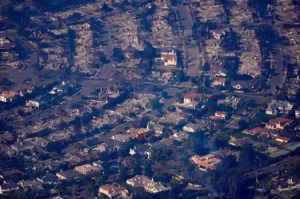 The Where is obvious: The areas where the homes burned down. Many will say however, rebuilding in these fire areas is stupid. But with a series of specific construction requirements, homes can be fire hardened and when coupled with some infrastructure improvements to aid in firefighting efforts, we can rebuild where we were before.
When is as soon as practicable, clearly. It also means building in phases. This is arguably the trickiest part of my approach because phases are usually built on contiguous lots. Moreover, there are differences in homebuilder quality and I can envision a situation where one builder is preferred over another and this would create a “hop scotch” effect diminishing efficiency. While this is a problem and one exacerbated by homeowners doing their own thing, separate from the government backed national home builder program, I believe this can be worked out. In terms of timing part of The When, lottery might be one solution. This too is a delicate challenge, but no plan is without challenges. Remember, there is monetary incentive to these homeowners to participate in this program.
Why approach rebuilding in this fashion? Frankly I can see no other path forward. As mentioned, City Planners do not have the capacity to process all the building applications even if super streamlined. The shortage of labor and materials is going to crush efforts to rebuild and drive the costs through the roof. Only by leaning on national home builders to make up the bulk of the rebuilding effort, will rebuilding happen in a timely and cost efficient way. Even with this approach it’s a daunting challenge to control costs, but on a onesy-twosy basis? Forget it.
Finally, we come to The How and this can largely be gleaned from the other 5 questions. The main How is to get the builders involved in laying out a compensation structure that truly incentivizes them to work with our cities. It can be a huge win for home builders and their shareholders while equally benefitting the public interest.
 The reality is this: Without decisive action by leadership, many homeowners will not rebuild. The elderly, the under insured, those who own due to generational wealth: “We live in Grandma’s home, but aren’t millionaire Hollywood moguls etc.” These folks do not and will not have the ability to rebuild. What happens to those lots? They will sell to the highest bidder. Ask yourself this, what happens to prices when many lots come on the market at the same time? Prices go down. So who do prices go down for? The most vulnerable and the least affluent. Then ask, what goes in their place? New custom homes. What do they look like? How large will they be? How does this affect the culture and heritage of the community? Ultimately the key to success is leadership. Consider two approaches to disaster rebuilding efforts in California. The Loma Prieta Earthquake of 1989 caused the freeway along Fisherman’s Wharf to be demolished. The discussion of what to do there, quite literally took years. While San Francisco waited for decisions, 4.5 years later the 1994 Northridge Earthquake happened and the 10 Freeway was damaged making a primary artery for LA inaccessible for commuters. Swift action by LA leadership at the time, had workers working 24/7 and the freeway was repaired and up and running in no time. Meanwhile SF leaders were still mulling the Embarcadero Freeway and what to do. Without question leadership is paramount and with great leadership, the afore mentioned plan will work. Will everyone be happy? Of course not, but I believe it is the only logical course of action. (Contact Tim here)


 The Real Estate Conversation